
 In the words of LT Pete "Maverick" Mitchell, "I feel the need....the need for speed!" Well, at least that's what Intel is feeling as it just announced that it will be putting its absurd 72-core Knight's Landing supercomputer chip into production. However, that isn't even the most exciting part. The most exciting part is that the Knight's Landing, which is Intel's fastest chip to date, will be going into desktop workstations that will contain enough computational power to make Doc Brown's overloaded speakers look like a kids karaoke machine.
PC World recently reported that the company is planning on shipping a "limited number of workstations" that will come equipped with the super-fast supercomputer chip in the first half of 2016. As a result PC makers will have the ability to adopt Intel's supercomputer silicon in desktop models on a greater scale, according to Intel's Charles Wuischpard. I don't know about you, but I'm not sure I can handle a chip like this being in something that is sitting in my room or my office. But then again the power is very alluring.
The main question that is going to be on everyone's mind is, of course, what kind of specs we can expect from the Knight's Landing chip. This chip differs from the ones currently in your desktop in the fact that this supercomputer processor puts all of its cores onto a single piece of silicon. Then, all of these processors are bundled up with 16GB of on-package MCDRAM memory into a PCI-E add-in card. This is very similar to the ridiculous Nvidia GPUs that are currently being installed on supercomputers around the world.

Once you have all of this packed together and installed inside your computer you are left with a piece of hardware that is capable of computing single-precision calculations at a rate of 8 teraflops, or double-precision calculations at over 3 teraflops. PC World also noted that this chip will be used by the United States Department of Energy inside of its 9,300-core Cori supercomputer and, in addition to that, Intel has also claimed that 50 different manufacturers will ship systems that use this chip in time.
In the meantime the desktop workstations, which are essentially jacked up versions of the CAD, graphics and film editing computers that are used in offices where money is as abundant as air, will be made available to researchers who are interested in using a supercomputer but are otherwise unable to gain access to one. The idea is that these individuals will be able to develop and test code on the workstation before shipping it out, error-free, to a supercomputer somewhere in the future. I highly doubt that you will be getting something like this in your iMac anytime soon, though Intel is, at the very least, attempting to put this chip into the hands of people that would otherwise have no access to such a device.
Content originally published here
Sharing this story on social media? Use these hashtags! #Intel #KnightsLanding #Supercomputer


 In a very sad announcement, it has been discovered that CEO and Chairman of the Board at Micron Steve Appleton died in a plane crash earlier this morning in Boise, Idaho. 51-year old Appleton was in the process of flying an experimental fixed-wing plane at the time of the accident.
 Put your eye on the problem with
  Intel has just announced their newest product, the Intel SSD 320 Series, which represents a significant upgrade to Intel's existing lineup of solid-state drives. According to Intel, this series of SSD can have up to 600GB and improves performance all while having a better price than the current X25-M Series. This new SSD definitely fulfills Intel's promise of their 25-nanometer multilevel cell flash manufacturing process. This process increased production in 2010 and increased SSD capacity points while also reducing production costs by cramming 8GB of storage onto a single 167mm flash die.
  Find out what is going on in the
 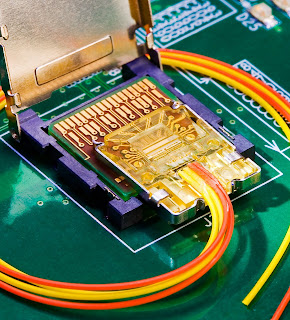 The technology world loves rumors, in fact, I think that they live, breath, eat and sleep rumors. I feel that if there were no internet rumors, then we would have a lot of depressed computer people out there with nothing to do to fill their free time. It's quite sad really. But, alas, we have another rumor floating around the internet that all the little techies are drooling over and that is the rumor that Intel will officially launch its Light Peak high-speed connection technology this Thursday.

 The tech world has been buzzing over Intel's second generation of processors known as "Sandy Bridge", but now they might be buzzing in a slightly different way as a major design flaw is stirring things up with not only Intel but other technology companies that have invested in devices using the processors.
 The second generation core processor family, otherwise known as the Intel Core 2011 processors, has finally arrived. There have been months of teasing accompanying on-stage demos, but the details on the Core i3, i5 and i7 processors are finally coming out and, considering the fact that there are a total of 29 new CPUs as well as a new integrated graphics options (processor graphics), there is a lot to mull over.

 On Wednesday, Gateway updated their ZX series that includes mid-ranged and high-end all-in-one desktop computers.
  Desktop computers have been forced to change their faces in order to not be considered obsolete. They are constantly being outdone by the convenience and speed of laptops, notebooks, and netbooks. The Apple iMac 27-inch (Core i7) is a fantastic example of an multimedia, all-in-one desktop computer. In many ways, it resembles its predecessor, the Apple iMac that featured a Core 2 Duo processor, except this iMac 27-inch (Core i7) is much faster.
 Be prepared for a new generation of netbooks and desktops because Intel has just officially announced its newest line of processors. Intel has a new processor for netbooks as well as 2 new processors for desktop PCs. The Pine Trail Atom N450 will be put into next generation netbooks along with a new low-power Intel NM10 Express Chipset. New Desktops will be integrated with the Pine Trail Atom D410 or the dual core D510 which also comes paired with the NM10 chipset.